Petra Platzer, PhD NBC-HWC, PCC: SixSEED Partners
BACKGROUND
SixSEED Partners (SSP) has partnered with the Patient Care Services and Nursing (PCS/Nursing) division at a large Academic Medical Center (AMC) for four years. The work has been grounded in a shared understanding: sustainable impact for patients, the workforce, and the organization is a function of leadership capacity – how consistently leaders can think, relate, and act in alignment with purpose under real conditions.
From the outset, this partnership has been championed by the Chief Nursing Officer (CNO), who has been clear that leadership development is not an event, but an ongoing practice embedded in the work itself. Over time, SSP has worked across multiple levels – from frontline managers to vice presidents – to strengthen both performance and well-being through integrated leadership development.
CONTEXT
In December 2024, SSP facilitated a full-division session for PCS/Nursing leaders and frontline managers. The focus was aligning around the 2024-2027 Strategic Plan and Quality and Safety priorities, while reinforcing a culture of shared ownership: “we” rather than “us and them.”
This mattered because, at this scale, strategy is not executed through plans alone. It is realized through how leaders align, decide, and act together in daily operations.
Following the session, the CNO identified a pivotal next step: to continue scaling leadership across the division, development needed to begin with her and her VP team. Sustainable change would require not just direction from the top, but visible shifts in how leadership was practiced at that level.
STRATEGY
SSP engaged the VP team in a team coaching approach designed to build shared leadership capacity in real time, while supporting the CNO in orienting strategically across the broader organization.
The work began with team and stakeholder discovery, followed by identification of three priority shifts:
1. Strengthening leadership continuity (succession planning)
2. Expanding strategic competencies
3. Distributing leadership through empowered teams
A distinctive element of this work was the introduction of the Big 5 of Strategy Competency Assessment, developed by Tim Tiryaki and Jeroen Kraaijenbrink. This evidence-based tool makes strategic capability visible and developable, shifting strategy from an abstract expectation to a practiced leadership competence.
After experiencing the assessment’s impact for themselves, the VP team chose to extend the assessment to their Directors, simultaneously advancing all three of their development priorities.
SOLUTION
Over nine months, the VP team translated development into operational shifts – how they meet, align, and make decisions together. They established a shared purpose, evolved interaction patterns, and strengthened their ability to lead with greater autonomy, proactivity, and strategic orientation.
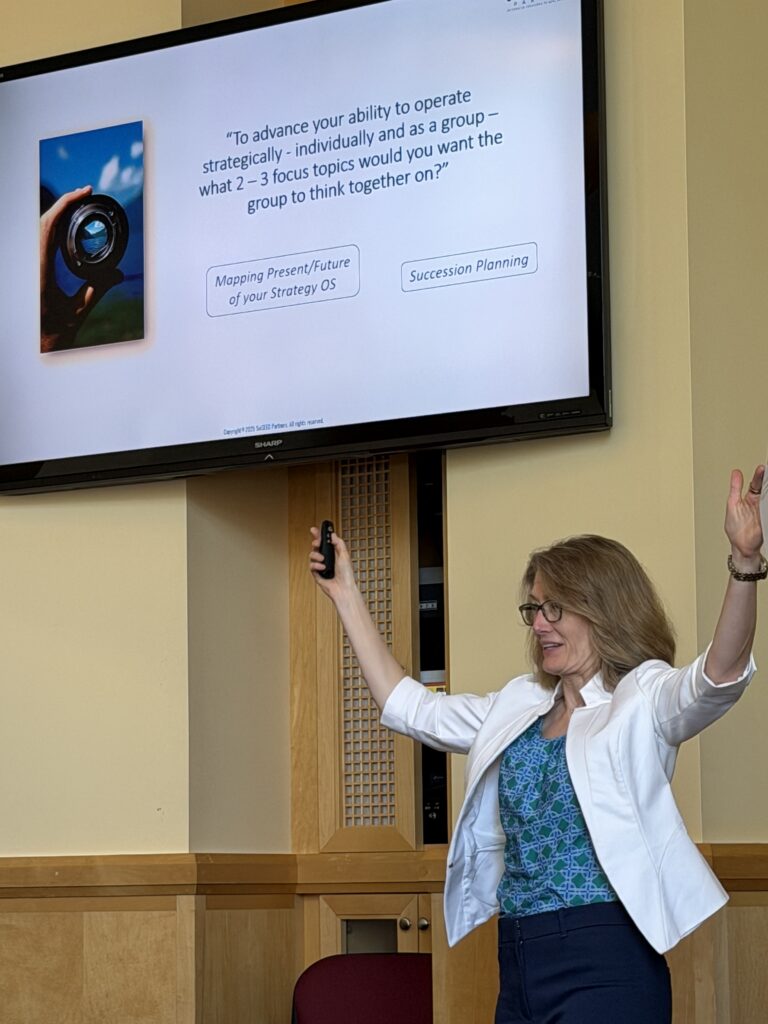
This work culminated in a full-day retreat with the VP team and their Directors focused on Scaling Leadership Capacity through Strategic Competencies. Facilitated by SSP’s Drs. Platzer and Deal, the session centered on two core competencies: “Grasp the Present” and “Shape the Future”, and bridged the VP team’s development journey with the Directors’ next stage of growth.
A defining moment in the retreat was a “fireside chat,” where the VP team openly shared their learning edges, mindset shifts, and evolution as a leadership group. The CNO set the tone by reinforcing the importance of investing in development amid ongoing operational demands.
This moment functioned as a system signal: leadership is not about having all the answers, but about modeling how to learn and evolve together.
“The Directors in the room all named the positive impact of hearing the VPs share their own journey. Their authenticity created permission for others to step onto the same developmental path.”
The session’s core focus was helping leaders understand both the strategic competencies and each other’s individual and collective strengths. A key insight emerged:
The group demonstrated strong capability in “Moving the System” and “Adapting to Change” – anchored in execution (doing). At the same time, they identified a need to strengthen the thinking dimension – reflection, sense-making, and strategic framing.
This pattern is common in high-performing nursing environments: strong execution capacity, with less protected space for strategic thinking. Naming it allowed the group to make it a shared priority, with direct application to their Annual Operating Planning process.
IMPACT
Over four years, this partnership has illustrated what it means to scale leadership from the inside out.
The PCS/Nursing division has strengthened not only individual leadership capability, but collective capacity – leaders increasingly able to align around shared purpose, operate as a system, and bring their teams with them.
The VP team entered team coaching as a high-functioning group. They have evolved into a shared leadership team, with greater capacity to think strategically, act collectively, and develop others in the flow of work.
As the Directors step into this same developmental pathway, those shifts are extending further into the organization, creating conditions where operational excellence and leadership development reinforce each other, rather than compete for time and attention.
At the center of this work is the CNO’s leadership – her willingness to go first, to be visible as a learner, and to build structures that support her team’s development. Her consistent investment in this work reflects an important form of executive courage and is precisely the kind of visionary leadership that makes sustainable change possible.