• Skip to primary navigation
  • Skip to main content
  • Skip to primary sidebar
  • Skip to footer
SixSEED Partners

SixSEED Partners

  • Our Services
  • Our Team
  • Our Results
  • Our Resources
  • Contact

Joy Goldman

Accountability and Feedback

July 5, 2022 by Joy Goldman Leave a Comment

By Joy W. Goldman RN, MS PCC:  CEO SixSEED Partners

In a recent discussion with a colleague, we were discussing an observation that there appears to be reluctance on the part of some front-line patient care leaders to hold staff accountable for “bad behaviors.” What is cited as the reason for the reluctance is the fear of losing “a warm body” and not being able to find replacements. I immediately felt myself react, not so much to the observation as to the term “bad behavior.”

What is it we label “bad behavior” and what impact does that have on our holding others accountable and providing constructive, performance feedback?

  • Bad behaviors are those which are foreign to you as a leader – they are behaviors that are least like you.  In fact, rarely would people use those terms to describe you
  • Bad behaviors are disruptive to the natural and normal flow of the workplace
  • Bad behaviors lead to negative outcomes within your team, patients, and other departments

What’s the risk in labeling behavior as good or bad?  Having done this in the past, as is human nature, the label of judgment and my resulting attitude and mindset only serves to upset me further as I obsessively confirm my belief yet do nothing about it.
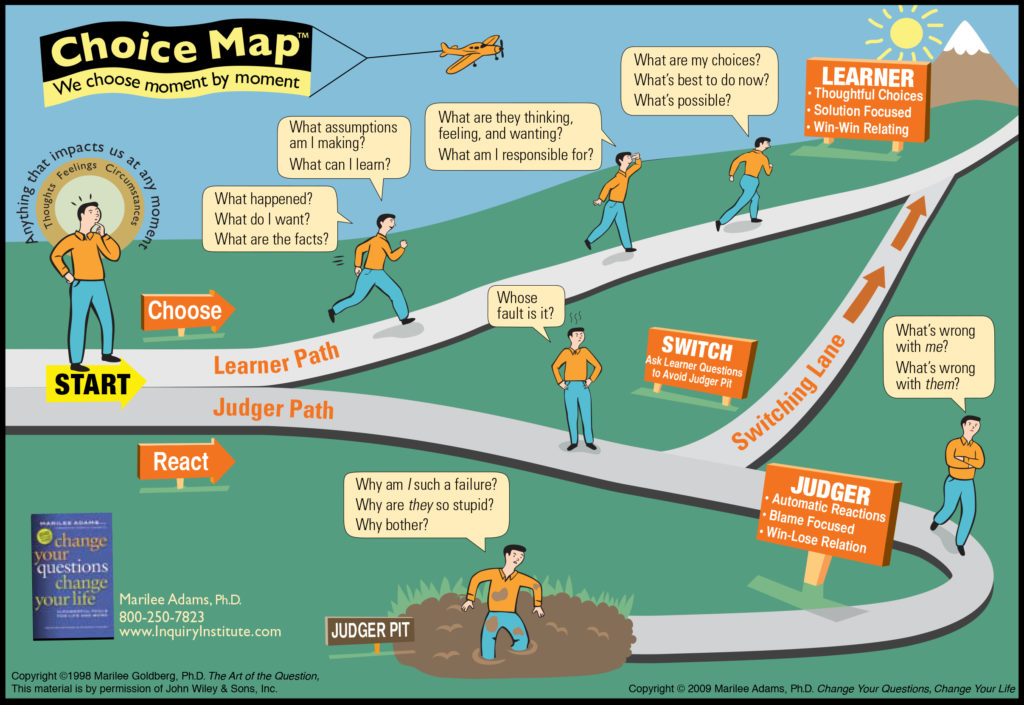
As Marilee Adams teaches us with “the choice map” and her book: “Change Your Questions, Change Your Life,” we can be more effective leaders and heal ourselves if we can switch from the judger path to the learner path.  This is the time to get curious—

  • Who is informing this individual about the impact of their behavior on others?  Might people be doing work-arounds or avoiding them instead of offering perceptions and entering into dialogue?
  • What might be motivating the behavior that is causing the adverse outcome?
  • What development opportunity exists for this individual and how am I supporting that?
  • How does this behavior that I’m witnessing relate to my strengths, or my own opportunities for development?
  • How might this disruptive behavior be exactly what is needed for the team to improve and grow?
  • How is this behavior different from the majority and how are we embracing it as a unique expression of a different culture? What evidence do we have that there are negative patient/ system outcomes?
  • How might I demonstrate compassion for myself and this individual as I speak to them directly about the impact of their behavior?
  • Can I shift my internal belief system that “holding accountable” is a systemic feedback process that carries no greater emotional weight other than that which I place on it?

If you find yourself wrestling with these questions, contact us.  We’d welcome supporting you!



Filed Under: Uncategorized

Leadership: An Inside-Out Job

June 22, 2022 by Joy Goldman Leave a Comment

“As you announce peace with your mouth, make sure that greater peace is in your hearts. Let no one be provoked to anger or scandal through you, but may everyone be drawn to peace, kindness, and harmony through your gentleness. For we have been called to this: to heal the wounded, bind up the broken, and recall the erring.” St. Francis of Assisi

If you are a C-Suite Leader in Healthcare, this blog will challenge your thinking and belief systems—if you are courageous enough to be curious. If you are wedded to the status quo and believe your perception of reality is the truth, read no further. If we want to stem “the great resignation”, we must start with ourselves. Leadership is an inside-out job!

At SixSEED Partners, we have the privilege of partnering with senior-level leaders on their development. Our mission is to provide integrated solutions to heal healthcare. In recent posts, we’ve applauded the work of the leaders at www.innerdevelopmentgoals.org: transformational skills for sustainable development. With scientific advisors like @jennifergarveyberger, @ottoscharmer, @petersenge, @robertkegan, @dansiegel, and @amyedmondson, this enlightened coalition knows that if we want sustainable change in our world, we must focus on changing ourselves. You can read more about their work in our prior posts.

What does this have to do with a challenge of our time: “The Great Resignation?” My motivation to write comes after hearing and witnessing repeated stories of senior-level, Vice-President or C-Suite leaders who have been asked to leave their positions and have been dealt with as if they were criminals. Some have been notified virtually and then asked to clean out their offices that they can only access with an escort and supervisor. Many have been informed that they cannot say good-bye to people they have hired and worked with for decades. Those at the organizations have been told that they cannot reach out to these leaders with whom they’ve done what many would consider combat duty.

What assumptions drive behaviors such as these? Perhaps: “we need to safeguard the organization from bad press;” “the individual will respond in anger and want to retaliate against us;” “since our perceptions of performance differ, we can’t trust this person and must act with control-power over.”

Here’s the challenging thinking part: I ask you: How do these very beliefs contribute to the manifestation of your own fear? In your efforts to protect, what cultural messages are being conveyed to your leadership team and the rest of the organization? It would seem this message is loud and clear: “If this is how our senior leaders are treated, then we are not safe and it’s each person for themselves!” No wonder people are resigning!

How might we lead differently so that we create the cultures we desire? The Inner Development Goals (IDG) suggest we cultivate the competency of Presence as part of Being: Relationship to Self:

Presence
“Ability to be in the here and now, without judgment and in a state of open-ended presence.”

Might we lead with safety for the organization AND safety for the individual? What would that look like? Perhaps we might see these behaviors:

  • Validated behavioral assessments administered in the selection and hiring process that continues upon hire as part of a proactive development strategy
  • Ongoing dialogue and mutual assessment around capacity and performance so there are no surprises
  • Courageous conversations that are grounded in relevant and timely situations to assess and challenge thinking and the ability to adapt and grow
  • Belief in the human being’s desire to serve and exploration around best fit—for them and the organization
  • If parting is necessary, a co-created exit plan that provides safety for the organization while respecting this person who has sacrificed much of their life in service to their job
  • A way to honor how they want to say good-bye to those with whom they’ve served

Behaviors like these require a different way of thinking. They require presence. If you’d like support for you and your leaders in how to sustainably shift individual and organizational mindsets so that you can be a place that attracts the type of leaders you most need, contact us.


That is our work—at SixSEED Partners and for our time.


Filed Under: Uncategorized

SixSEED Sustainable Change and Inner Game

June 9, 2022 by Joy Goldman Leave a Comment

“Nations United: Urgent Solutions for Urgent Times.” This 34-minute film by the United Nations speaks to the urgent need for sustainable change in our world. As Peter Senge was speaking to a group attending a May 25th, 2022 Inner Development Goals gathering around the UN’s 7-year- old Sustainable Development Goals (SDGs), I was saddened to hear Peter comment that those in the United States speak the least about these as compared with the rest of the world. As you read this, do you know what I’m speaking of? If not, why not?

Vinay Kumar and I will be continuing our work with the patient care and nursing leaders at an academic medical institution and we will be focusing on “the inner game.” Tying into the work of the IDG, we cannot hope to create sustainable change if we don’t first focus on changing ourselves. We can no longer afford to be pointing our fingers at others in blame: we must take radical responsibility and develop and evolve our thinking so that we can act in ways that honor each other, our families, our communities, our planet. As CEO of SixSEED Partners, I am proud to support this work and to work with colleagues who do the same.

You can read more about the IDG Framework at this link: https://tinyurl.com/bdzxshmx.

Filed Under: Uncategorized

SixSEED Honors National Hospital Week

May 9, 2022 by Joy Goldman Leave a Comment

Thanks to the American Hospital Association for producing this video honoring healthcare workers: “America’s Healthcare Workers are Worth Fighting For.” Especially during National Hospital Week, SixSEED Partners wants to honor everyone who works in healthcare for their dedication and commitment to serve. Your dedication is evident in this heart-wrenching, yet common story from a Healthcare Leader:

“I don’t think I slept for the entire year of 2020. When Covid hit, my role required me to serve in our hospital’s command center. With a newborn at home, I would sleep by myself in the basement to avoid the risk of exposing the rest of my family to Covid, should I happen to be infected and not know it. To allow my partner to get their rest, I would sleep 2-3 hours and then get up to feed the baby before heading back to the command center.”

As I witnessed this leader summon the courage to allow himself to cry, I was also moved to tears, knowing this was just one story of many that were just like this. As this leader told his story, it was told with humility and a work ethic of loyalty and servant leadership. And the tears were the culmination of two years of “just doing his job.”

This year saw hospitals have to do something they’ve never had to do before: ration healthcare. During National Hospital Week, take a moment to thank your healthcare and hospital workers. More than thanks, commit to taking action to keep yourself healthy to avoid preventable diseases so that we ALL have access to quality healthcare.

Learn more about National Hosptial Week at https://www.aha.org/ahia/get-involved/national-hospital-week.

Filed Under: Uncategorized

Fixers Anonymous: “A 12-Step Program for ‘Fixers’” (Steps 10-12)

May 5, 2022 by Joy Goldman Leave a Comment

By Joy W. Goldman RN, MS, PCC: A recovering fixer!

We continue our post stress management strategies for those of us who identify as “I’m a fixer!—I fix things!”

Fixing, also known as problem-solving, is a valuable skill, until we approach everything in our work and personal lives as problems to fix. Here we’ve adapted the time-tested 12-step program from Alcoholics Anonymous to habitual problem solvers/ fixers for steps 10-12.

10. We continued to be aware of our risk of overusing problem-solving/ fixing thinking and when we were wrong, promptly admitted it. We enlisted the support of key strategic partners to ensure we were distinguishing problems from polarities (complex challenges). An often heard question was: “Whose perspective/ voice are we missing that we need to bring into our conversation?” We found ourselves noticing the common tensions of leveraging local needs with system needs; having a communication style that was direct along with a more diplomatic one when that was called for. We focused on the quality of our work as we also focused on the cost of our work. To everyone’s delight, we also spent time talking about nurse and physician well-being along with patient and organizational well-being.

11. We sought out prayer and meditation experiences to improve our ability to notice in the moment and correct our responses. Knowing that the demands would not cease, we learned to assume responsibility for caring for ourselves through daily health habits like exercise; mindful and healthy eating; taking time-outs from electronic devices and spending focused time with family, friends and alone time. We began a daily spiritual practice that allowed us to feel connected to something larger than ourselves.

12. Humbly acknowledging our risk of overusing fixing to the detriment of sustainable and systemic change, we commit to cascading our learning to others who may be so afflicted. As I humbly and courageously worked on developing myself, I noticed that there were others on my team who shared this love of “fixing.” My modeling asking for feedback and being curious was a powerful invitation for them to do the same. I realized that it wasn’t sufficient for me to modify my behavior, alone: I had to help others find healthier ways of partnering and perceiving that created a culture of health and well-being for ALL. I now devote at least 15 minutes during my 1:1 meetings and during our team meetings to focus on our individual and collective development. We also engaged SixSEED Partners to help us identify our key tensions and then measure and create action plans around better leveraging these tensions so that we achieved sustainable change and progress with less expense to the system and to us!

If you need more information, please email info@sixseedpartners.com and they’ll be happy to support you! You can find some case studies around this work by going to: https://sixseedpartners.com/resources/.

Filed Under: Leadership Development, Six Seeds, Uncategorized

Fixers Anonymous: “A 12-Step Program for ‘Fixers’” (Steps 7-9)

April 28, 2022 by Joy Goldman Leave a Comment

By Joy W. Goldman RN, MS, PCC: A recovering fixer!

We continue our post stress management strategies for those of us who identify as “I’m a fixer!—I fix things!”

Fixing, also known as problem-solving, is a valuable skill, until we approach everything in our work and personal lives as problems to fix. Here we’ve adapted the time-tested 12-step program from Alcoholics Anonymous to habitual problem solvers/ fixers for steps 7-9.

7. We humbly asked our higher power to supplement our fixing habit with a healthy alternative. We bravely acknowledged that we didn’t have all the answers and could allow ourselves the opportunity to learn and expand our toolbox, while also providing an opportunity for others to develop their skills. We also realized that we didn’t have to abandon our “fixing” high but that we could complement it with something called polarity thinking- both/and thinking.

8. We made a list of all persons we had harmed and became willing to be transparent about our steps to recovery. In our haste to be the one with the one right answer, we acknowledge that we dismissed other’s perspectives, often making them feel devalued. At this time of “the great resignation,” we know we can’t afford to do that and we need every talented resource we can get to be successful. During our 1:1’s and team meetings, we fessed up and apologized for our previous dismissive behavior and committed to change. We asked our peers and team members to provide us feedback when they noticed positive changes and when they also noticed our inevitable remissions.

9. We made direct amends to people we had harmed unless doing so would injure them or others. For those whose perspectives had been dismissed, we now purposefully asked for their perspective as we were challenged by complex issues. Instead of trying to surface one right answer, we purposefully looked for numerous perspectives and seeming contradictions. Our goal became more about getting several voices and perspectives in the room, often from those who generally had opposite preferences from the majority.

Filed Under: Leadership Development, Six Seeds, Uncategorized

  • « Go to Previous Page
  • Page 1
  • Interim pages omitted …
  • Page 4
  • Page 5
  • Page 6
  • Page 7
  • Page 8
  • Interim pages omitted …
  • Page 15
  • Go to Next Page »

Primary Sidebar

Recent Posts

  • Walking Our Talk: SixSEED Partners’ Strategic Team Retreat  
  • Strengthening Team Trust and Collaboration through an Experiential Retreat 
  • Both/And Thinking to Develop Human-Centered AI to Heal Healthcare 
  • Building Trust to improve Psychological Safety: An Experiential Team Approach
  • Building Team Norms to Sustain Team Effectiveness

Archives

  • November 2025
  • October 2025
  • April 2025
  • December 2024
  • August 2024
  • July 2024
  • June 2024
  • May 2024
  • April 2024
  • March 2024
  • February 2024
  • January 2024
  • November 2023
  • October 2023
  • August 2023
  • July 2023
  • June 2023
  • May 2023
  • April 2023
  • March 2023
  • February 2023
  • January 2023
  • December 2022
  • November 2022
  • October 2022
  • September 2022
  • August 2022
  • July 2022
  • June 2022
  • May 2022
  • April 2022
  • March 2022
  • February 2022
  • January 2022
  • December 2021
  • November 2021
  • October 2021
  • September 2021
  • July 2021
  • June 2021
  • May 2021
  • April 2021
  • March 2021
  • January 2021
  • December 2020
  • November 2020
  • October 2020
  • September 2020
  • August 2020
  • July 2020
  • May 2020
  • April 2020
  • September 2019
  • August 2019
  • June 2019
  • April 2019
  • September 2018
  • August 2018

Categories

  • Case Study
  • Coaching
  • Culture
  • Diversity and Inclusion
  • Epidemic Leadership
  • Leadership Development
  • Leadership Ecosystem
  • Polarity Thinking
  • Six Seeds
  • Succession Planning
  • System Integration
  • Team Development
  • Transformational Leadership
  • Uncategorized
  • Well-being

DRIVING TRANSFORMATIONAL CHANGE IN HEALTHCARE

Offering a suite of inter-collaborative, interdependent and custom-designed services to increase leader and system-level capacitation within the healthcare industry, SixSEED Partners drives sustainable, transformational change within leaders, teams and entire organizations.

“Life does not accommodate you; it shatters you. Every seed destroys its container, or else there would be no fruition.”  —Florida Scott-Maxwell

[icon name=icon_phone] 443-379-4569
[icon name=icon_mail] info@sixseedpartners.com

[icon name=social_linkedin_square] Join our LinkedIn network.
[icon name=icon_clipboard] Get Insights on our Resources page.

© 2019 SixSEED Partners. All rights reserved.

  • 10431 Patterson Ave | Henrico, VA 23238
  • 443-379-4569
  • info@sixseedpartners.com
  • 2020 SixSEED Partners. All Rights Reserved

Footer

10431 Patterson Ave | Henrico, VA 23238

  804-220-1919

info@sixseedpartners.com

2025 SixSEED Partners. All Rights Reserved

HTML tutorial